The Global Psoriasis Atlas Field Study in South Africa – December 2023
5 January 2026
By IFPA
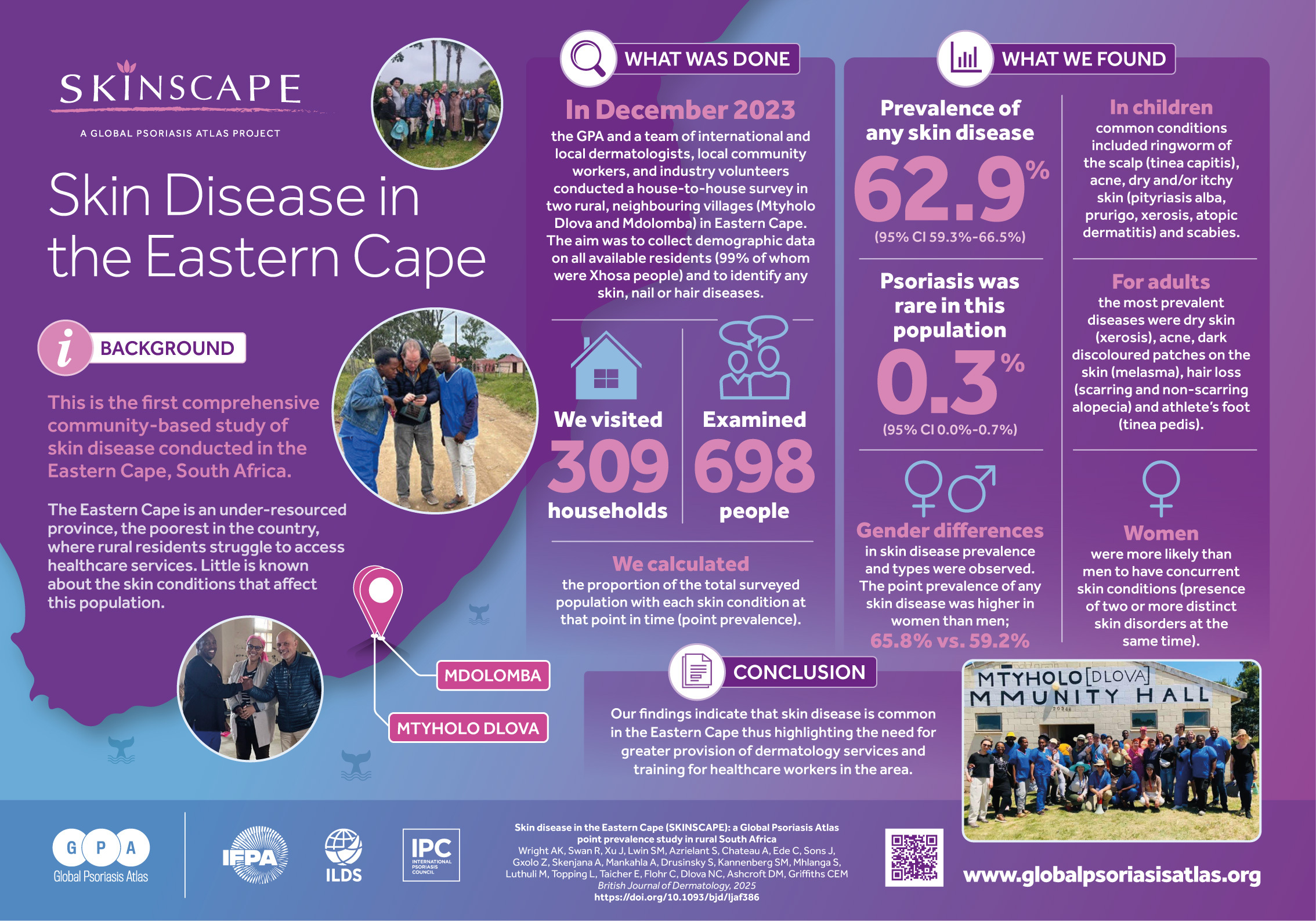
In December 2023 the GPA, in collaboration with Professor Ncoza Dlova, GPA Regional Coordinator, and a team of international and local dermatologists, local community workers and industry volunteers conducted a house-to-house survey in two rural, neighbouring villages (Mtyholo Dlova and Mdolomba) in Eastern Cape. This trip resulted in the publication of the first comprehensive community-based point prevalence study of skin disease in the Eastern Cape, South Africa.
Why the Eastern Cape?
For many skin diseases, inequalities in care are a result of a lack of knowledge, understanding of the disease prevalence, and delays in diagnosis and treatment. This can be even more profound in countries that are recipients of official development assistance (ODA) such as Sub-Saharan Africa. Data on the number of people who have skin diseases are sparse throughout the African continent. Without these data, it is challenging to target resources effectively and improve access to care.
The Eastern Cape is one of nine provinces in South Africa. It is an under-resourced province and the poorest in South Africa with high levels of poverty, illiteracy, and unemployment. Rural residents struggle to access healthcare services, in part due to a lack of transportation, and face barriers to treatment due to socio-economic reasons. Very little is known about the spectrum, distribution, and burden of skin disease in this region.
Where?
In December 2023, the GPA team, comprised of dermatologists from the UK, Israel, and South Africa, GPA researchers, and industry partner volunteers (UK & France), travelled to King William’s Town (Qonce). The survey was conducted across 6 days in two rural villages; Mtyholo Dlova and Mdolomba.
What?
The aim was to collect demographic data on all available residents (99% of whom were Xhosa people) and to identify any skin, nail or hair diseases. The team examined 698 residents across 309 households.
Results
The team visited a total of 309 households. In total, 439 people were identified as having at least one skin disease, with 100 different conditions identified in this population. The overall point prevalence of any skin disease was 62.9% (95% CI 59.2-66.5%).
Psoriasis was rare in this population with a prevalence of only 0.3% (95% CI 0.0%–0.7%).
Gender differences in skin disease prevalence and types were observed, and the point prevalence of any skin disease was higher in women than men; 65.8% vs. 59.2%.
Most prevalent skin diseases:
Children (<18 years):
- Tinea capitis (16.4%)
- Acne vulgaris (13.0%)
- Pityriasis alba (10.6%)
- Prurigo, PIH, xerosis, atopic dermatitis, and scabies also common
Adults:
- Xerosis (7.8%)
- Acne vulgaris (7.4%)
- Melasma (6.2%)
- DPN (5.6%)
- Scarring & nonscarring alopecia, tinea pedis
The prevalence of skin diseases was broadly similar across the two villages, sex-specific differences were observed in the presence of certain conditions; alopecia (scarring and nonscarring) and melasma were more prevalent in women whereas pseudofolliculitis barbae and tinea capitis was more common in men.
Impact
The team is committed to creating a lasting impact and fostering a legacy of knowledge and support for the communities involved. The local young people of Mtyholo Dlova and Mdolomba who volunteered as community workers were provided with training in data collection and diagnosis of skin conditions by the dermatologists. By the end the study, the community workers were able to diagnose common skin diseases themselves and the experience inspired a number of them to pursue an education and career in healthcare in the future.
The collaborative nature of SKINSCAPE fostered a rich exchange of knowledge and insights, particularly with the South African team. The international collaboration has provided a unique opportunity for cross-cultural learning, and the South African team, with their expertise in the presentation and diagnosis of skin diseases on black skin, made invaluable contributions to the broader understanding of dermatological conditions in different populations.
This project also garnered support from various industry partners worldwide, highlighting the importance of such collaborations in advancing dermatological research in underserved regions. Unilever generously donated large bags of skin care products and toiletries for every family of the Mtyholo Dlova and Mdolomba villages. Elsa Taicher (Global Professional Relations Manager, L’Oréal) facilitated the delivery of emollients and sunscreen for distribution by the SKINSCAPE team working in the two community halls and to the local hospital. Dr Zikhona Gxolo, an East London-based dermatologist attached to the Cecilia Makiwane Hospital, expressed her gratitude that so many of the emollients from L’Oréal were donated to the local dermatology clinics for use there due to the severe shortage they had been experiencing.
The GPA team will use the knowledge gained during the visit to refine the survey methodology for future field studies and continue to advocate for outreach engagement, particularly in underserved populations and regions, to provide evidence for better access to care for people with skin disease wherever they may live.
Watch the video: