Third Edition of the Global Psoriasis Atlas
5 January 2026
By IFPA
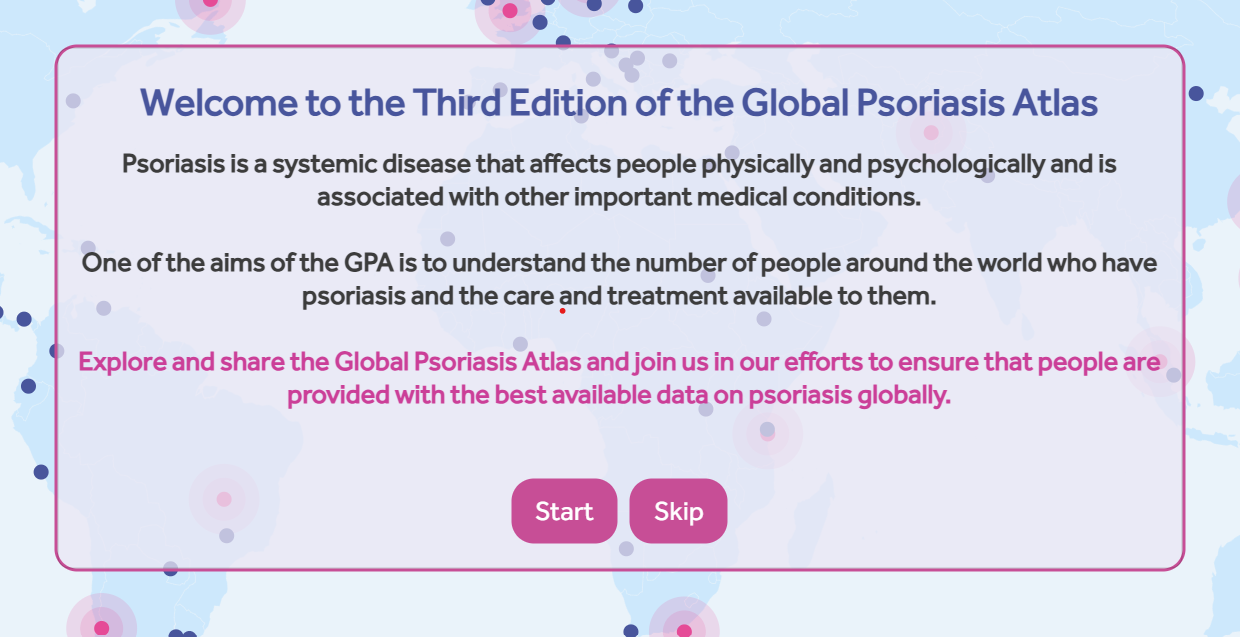
The GPA team was excited to release the third edition of the Global Psoriasis Atlas on World Psoriasis Day 2025.
Hosted on the GPA website, the Atlas is an open-access resource which provides comprehensive information about the global epidemiology of psoriasis. The third edition presents findings from the latest systematic review, including data on incidence and prevalence from 58 new prevalence only studies, 4 new incidence only studies and 11 new combined prevalence and incidence studies – now covering 41 countries across 14 global regions.
Dr Paul Dimmock, GPA Research Associate, and Dr Ahmad Aalemi, GPA Research Fellow, conducted an extensive search of all clinical research evidence and all the published articles on the incidence and prevalence of psoriasis. The information retrieved was assessed and used to create a statistical model. The statistical model generated a pooled estimate of the prevalence of psoriasis for each individual country where data were identified.
Each prevalence measure is presented on the GPA website with a credible interval — a range of values, with an upper and lower limit, in which the estimate lies with a specified probability. This data has a 95% credible interval, this means there is a 95% probability that the prevalence rate lies within that range.
Figures show an estimated 43 million (from 27 million to 91 million) people have psoriasis based on reporting physician/dermatologist diagnoses and an estimated 102 million (from 65 million to 218 million) people have psoriasis based on self-report cases provided by individuals.
The two different values presented are based on how psoriasis has been diagnosed:
- Physician/dermatologist diagnosed means a person has visited a medical practitioner, typically a general practitioner, hospital doctor or dermatologist, and had a formal clinical diagnosis of their skin condition confirming it is psoriasis.
- Self-reported diagnosis means a person was asked if they have psoriasis and they have responded to indicate that they did. This person might or might not have visited a doctor to receive a diagnosis, but the studies presenting these results do not confirm that a medical review was undertaken.
Considerable gaps still exist in the geographical areas reporting data on incidence and prevalence of psoriasis. Only 41 of over 220 countries and territories in the world have epidemiological data on psoriasis in the general population. For countries without high quality original data sources, estimates were predicted using the statistical model created based on available data.
Visit the GPA website to view, compare and download global prevalence data for individual countries: https://www.globalpsoriasisatlas.org/en/explore/prevalence-heatmap